
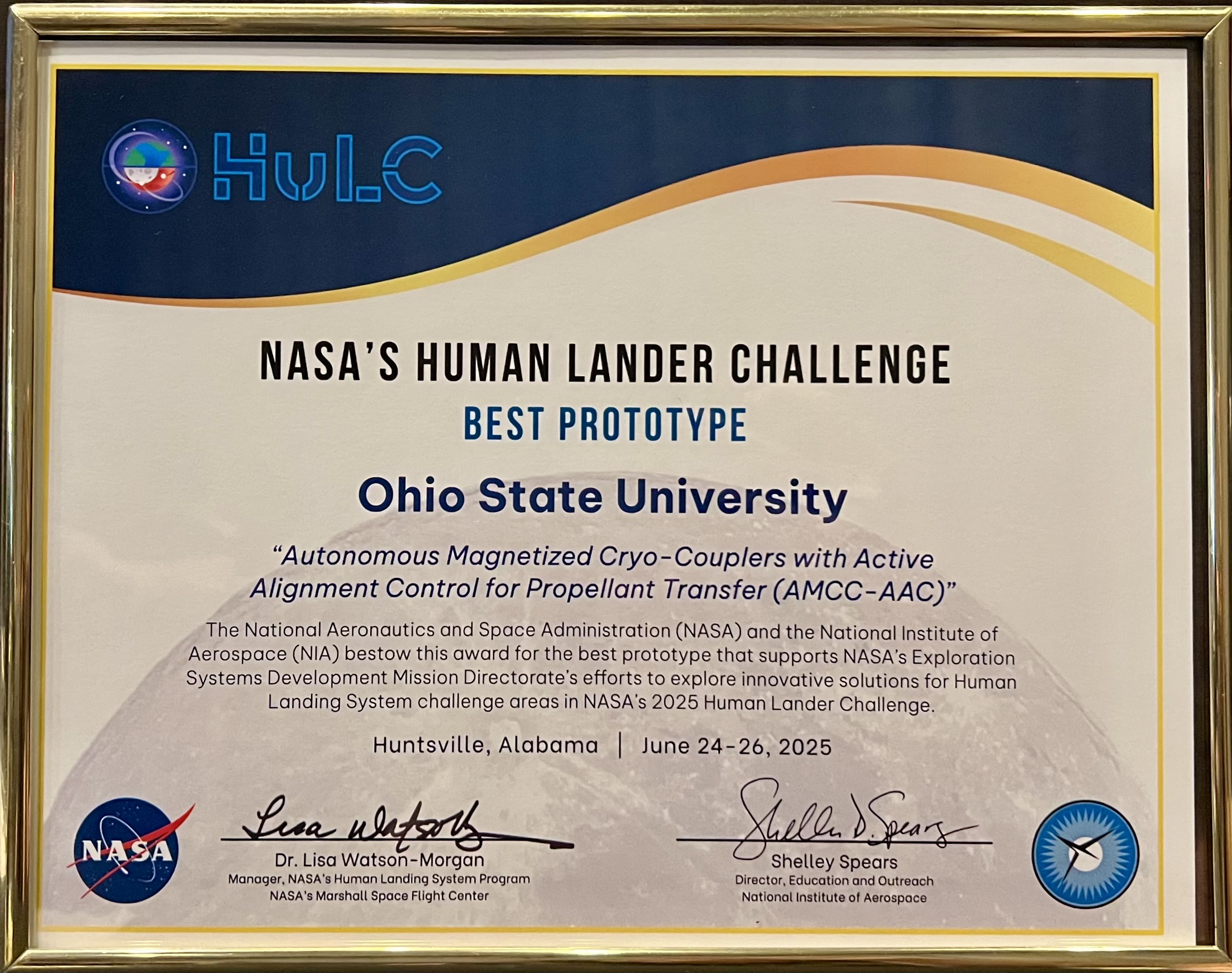
At the 2025 NASA Human Lander Challenge (HuLC) Competition Forum in Huntsville, Alabama, The Ohio State University HuLC Team was recognized with the Best Prototype award for our project: Autonomous Magnetized Cryo-Couplers with Active Alignment Control for Propellant Transfer (AMCC-AAC).
HuLC challenges university teams to advance “cooler” solutions for in-space cryogenic liquid storage and transfer—capabilities that are critical for long-duration missions where liquid oxygen and liquid hydrogen must be stored and moved reliably for weeks to months, not just hours.
Read the article published by Ohio State here: “Ohio State takes center stage in NASA technology competition”
What we built: AMCC-AAC
Our concept focuses on automated cryo-couplers: a docking/coupling interface designed to help spacecraft refuel autonomously. Building on the promise of existing magnetized coupler approaches (e.g., CryoMag-style concepts), AMCC-AAC adds active alignment control so the system can handle real-world misalignment and reduce the likelihood of a bad mate or leakage.
Key ideas we presented and demonstrated include:
- Guided alignment using onboard sensing (camera/LiDAR-style ranging and system state feedback)
- Actuation for controlled approach and capture
- Autonomy-ready architecture intended to reduce crew or ground-in-the-loop burden during refueling operations
Why “Best Prototype” mattered to us
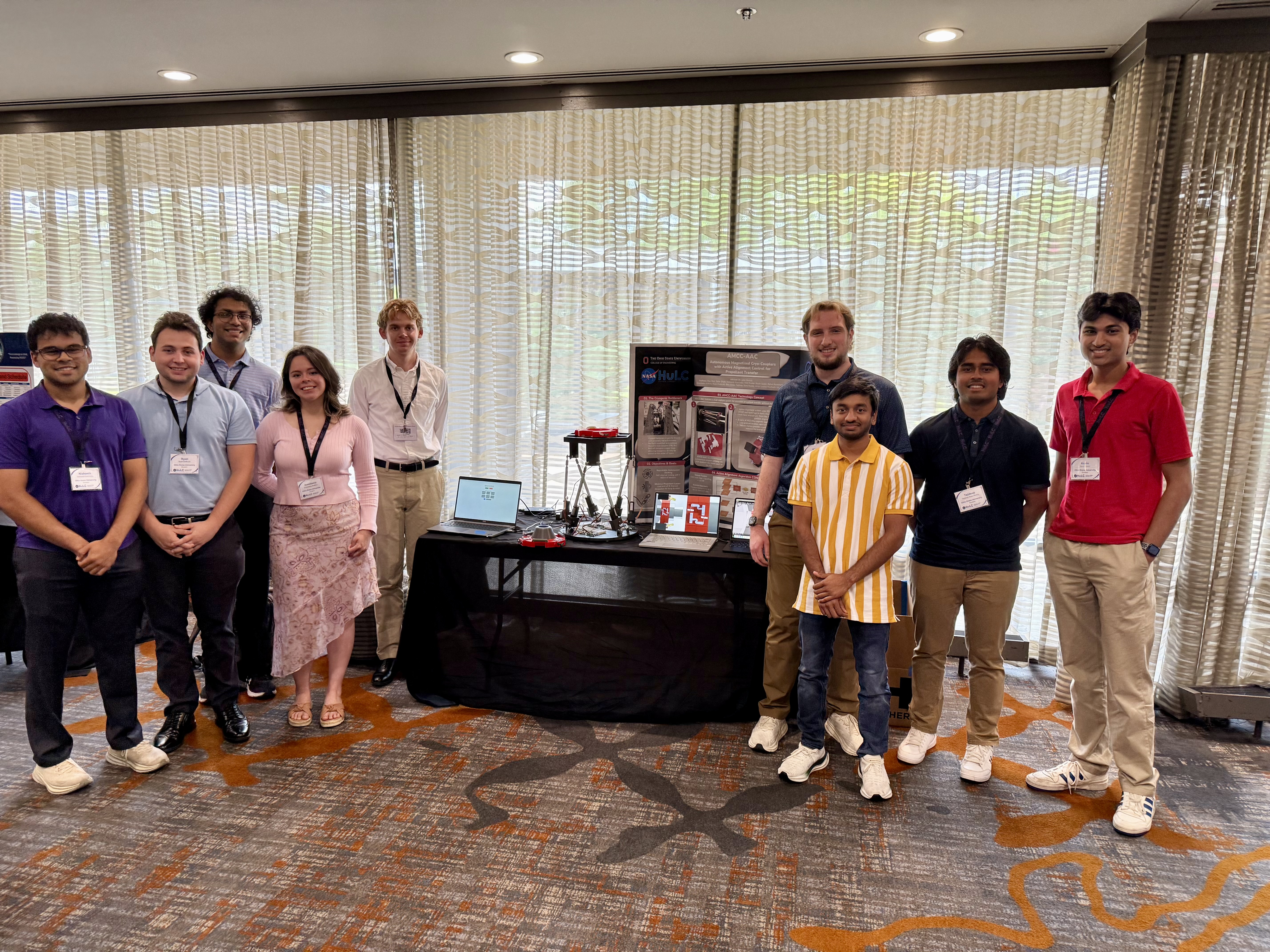
HuLC projects can be huge in scope, so we had to make intentional prototype choices under a tight timeline. We focused on demonstrating the most “judge-visible” functionality—a working physical prototype that communicates how the full system would operate in a real mission scenario.
Seeing the prototype come together and then earning the Best Prototype recognition was an awesome validation of the engineering effort our team put in across the concept, systems design, build, and integration work.
Thank you + what’s next
Huge thanks to NASA, the HuLC organizers, our faculty advisor(s), and everyone at Ohio State who supported the team. And of course—massive credit to my teammates for the long nights, fast iteration, and clean execution at the forum.
If you want the deeper technical dive (paper, poster, and presentation materials), you can find everything here: AMCC-AAC: OSU HuLC Team Project Page